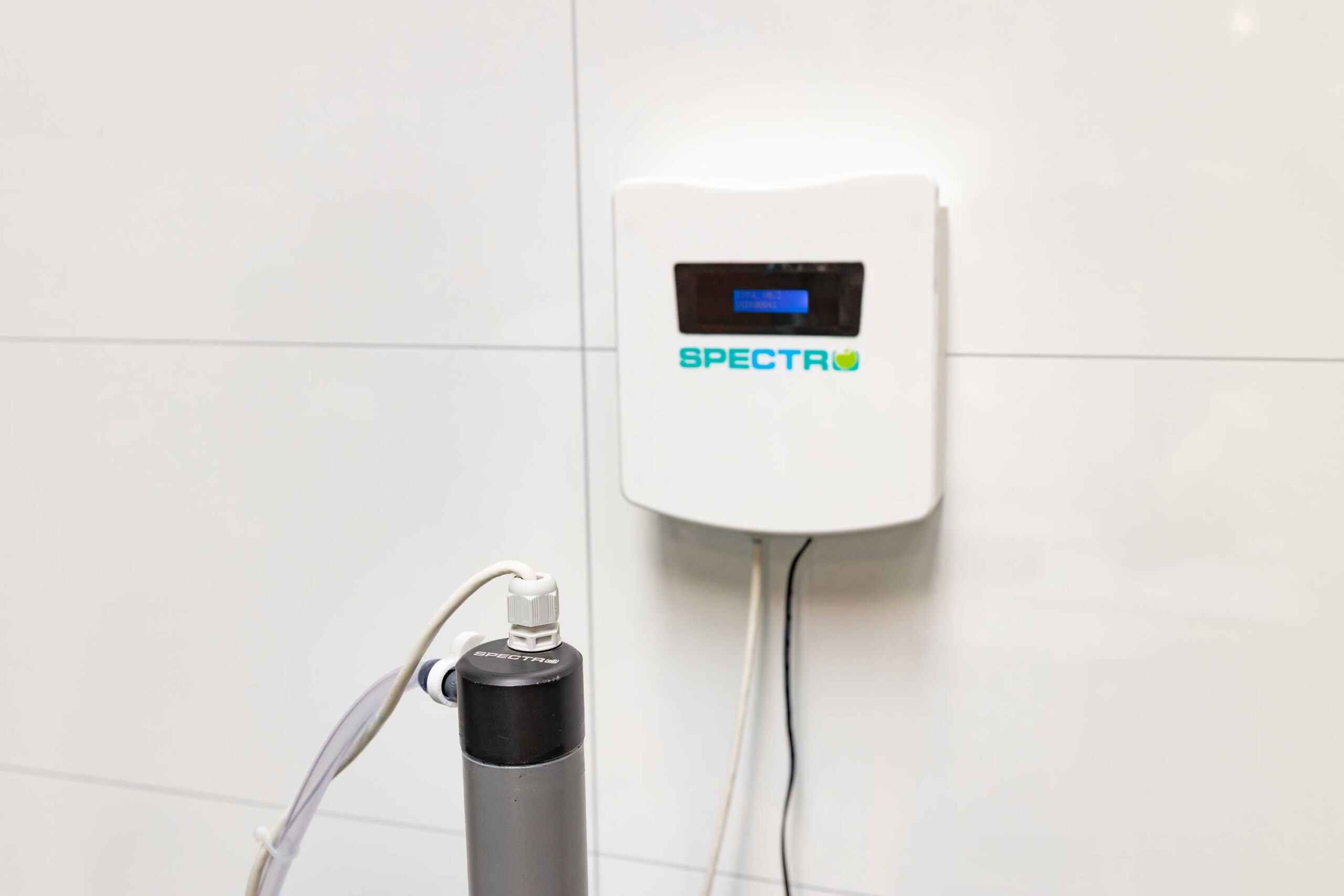

Never again ordering shampoo for your truck wash? That could mean two things. Either things are going badly, or you’re using Spectro’s empty tank detection system. “With this, we completely relieve the customer of their burden. And we’re also doing a little bit of that ourselves,” said Car & Truckwash Advisor Barend van den Boom.

We mainly use the empty return-to-origin detection feature for customers who use so-called IBCs: Intermediate bulk containers. “These are containers with a capacity of 300, 600 or 1000 liters,” Barend explains. “They are filled with, for example, shampoo for truck washrooms. Especially on busy days, the stock can quickly run out at such a location. And you’ll always see: you were so determined to order, but just that busy weekend you realize that you’ve run out of stock…”
No more worries
That scenario is a thing of the past thanks to the empty container detection system. Barend explains: “If the sensor in the IBC reaches a pre-determined minimum amount, a module with an internet connection automatically sends a signal. Then we replace the empty IBC in time for a full one. In short: you literally no longer have to worry about it.”
“Thanks to the empty form detection feature, you always have
the right amount of cleaning product in the house”
Always on top of things
The empty refill detection therefore prevents you from suddenly finding yourself without cleaning products. But on the other hand, there is also the benefit: overcapacity and overcrowded storage spaces are no longer an issue. “You always have the right amount of cleaning products in stock,” nods Barend. “Not too much and not too little. For us too, the empty refill detection has an advantage: it creates peace and clarity in our planning. We always help our customers everywhere and anytime. And we much prefer to do that in advance with a smart system, rather than during peak moments when the need is high.”
Other sectors
We are still investigating which sectors the empty tank detection is an enrichment in. For example, we recently started with car wash stations or car garages. Barend: “In carwashes, multiple products are often used, in tanks of, for example, sixty liters. Pre-rinser, foam, drying agents, polish, etc. As soon as employees manually fill those tanks, the empty tank detection signals the increased level. And so we know exactly when a customer has run out of their stock.”
Measurement is knowing
The first customers are also using the system in the food industry. And we continue to explore which other sectors could benefit from this solution. “Knowing is knowing,” said Barend. “Customers who use the empty-checkout detection are extremely satisfied. They are no longer afraid to forget an order. In fact: they can forget it. Because we already guarantee to take care of them.”
